Home > Blog
> Corrective Revision Hair Transplant: Corrective Hair Transplant in Karachi: Fixing a Bad or Faile...
Corrective Revision Hair Transplant: Corrective Hair Transplant in Karachi: Fixing a Bad or Faile...
By Dr. Mateen Ahmed
Aesthetician
•August 22, 2026•14 min read
Corrective Revision Hair Transplant is a critical topic for patients seeking clinical aesthetics.
Quick Answer: A corrective hair transplant repairs visible damage from a poorly performed first procedure — pluggy hairlines, unnatural graft angles, overharvested donor areas, and low-density placement. At SMC Aesthetics in Karachi, Dr. Mateen Ahmed uses DHI and Sapphire FUE to camouflage previous scarring and rebuild natural-looking density, though honest expectations are critical: correction improves significantly but rarely matches a well-executed first-time result.
What Goes Wrong With Cheap or Rushed Hair Transplants
Pakistan's hair transplant industry has grown rapidly over the past decade, particularly in Karachi. With that growth has come a surge in clinics offering extremely low-cost procedures — sometimes as low as PKR 25,000–40,000 for a full session. While this sounds appealing, the clinical reality is that cutting costs in hair transplantation almost always means cutting corners on the factors that determine whether your result looks natural or noticeably artificial.
Here are the most common problems we see in patients who come to SMC Aesthetics seeking corrective work after a failed procedure elsewhere:
1. Pluggy, Unnatural Hairline Design
This is the single most visible sign of a bad hair transplant. Instead of placing single-hair follicular units at the hairline (which is how natural hairlines grow), some clinics transplant multi-follicular unit grafts (containing 3–4 hairs each) directly at the front. The result is a row of thick, clustered "plugs" that look like doll's hair rather than a natural gradient from fine singles at the front to denser multi-hair units behind.
Correcting this requires removing or camouflaging these plugs — often by splitting them into individual follicles and re-implanting them at correct angles, which demands significantly more precision than the original surgery.
2. Wrong Hairline Angle and Direction
Natural hair doesn't grow straight up from the scalp. At the temporal regions, hair angles forward and slightly downward. At the crown, it grows in a whorl pattern. At the frontal hairline, the angle is approximately 30–45 degrees relative to the scalp surface. When a surgeon or technician doesn't understand or control these angles, the transplanted hair grows in visibly wrong directions — sometimes sticking straight out, sometimes growing backward. This cannot be fixed by simply shaving or styling; it requires extracting and re-implanting the grafts at the correct angle.
3. Overharvested Donor Areas
The donor area — the back and sides of the head where DHT-resistant hair grows — is a finite resource. A responsible surgeon harvests evenly across the safe donor zone to maintain uniform density. In high-volume "hair mills," technicians sometimes strip-mine a small area aggressively to save time, leaving a visibly thin or patchy donor region. This is particularly devastating because:
The damage is permanent — those follicles don't regenerate.
It limits the donor supply available for any future corrective procedure.
It can leave visible scarring or bald patches on the back of the head that are difficult to conceal.
4. Poor Density Distribution
A common shortcut in budget clinics is to spread grafts too thinly across a large area to create an illusion of coverage, or conversely, to pack grafts densely at the hairline while leaving the mid-scalp and crown completely untouched. Both approaches look unnatural. Proper density requires 40–50 follicular units per square centimetre at the hairline, gradually transitioning to 30–35 FU/cm² in the mid-scalp. Achieving this requires careful pre-surgical planning and sufficient graft allocation — not arbitrary placement.
5. Visible Linear Scarring (FUT Strip Damage)
Older FUT (Follicular Unit Transplantation) procedures involve cutting a strip of scalp from the donor area and suturing it closed. When done well, the resulting scar is a thin, barely visible line. When done poorly — with excessive tension, poor suturing technique, or on a patient with poor wound healing — the scar can be wide, raised (keloid or hypertrophic), and clearly visible even with moderately short hair. We see this frequently in patients who had their FUT procedure performed by general practitioners rather than trained plastic surgeons.
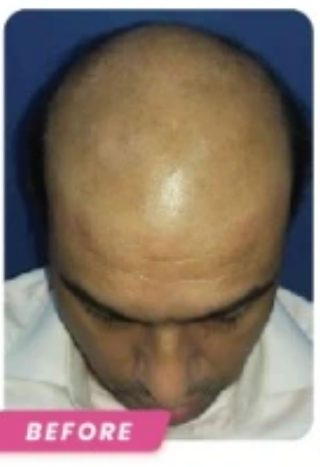
Before: A patient presenting for corrective assessment — note the uneven density distribution from a previous procedure.
Why Corrective Surgery Is Technically Harder Than a First-Time Case
Many patients assume that fixing a bad hair transplant is simply a matter of "doing it again, but better." The reality is significantly more complex. Here is why correction cases are categorised as advanced procedures that should only be attempted by experienced surgeons:
Limited Remaining Donor Supply
If 2,500–3,000 grafts were already extracted (or wasted) in the first procedure, the total remaining donor capacity may be reduced to 1,500–2,500 grafts for the correction. This means the corrective surgeon must achieve maximum impact with fewer resources — a constraint that doesn't exist in first-time cases where the full donor reserve (typically 5,000–7,000 total grafts over a lifetime) is available.
Existing Scar Tissue
Previous surgery creates scar tissue in both the donor and recipient areas. Scar tissue has reduced blood supply compared to healthy scalp tissue, which means grafts planted into scarred areas have a lower survival rate. The surgeon must identify where scar tissue exists, plan around it where possible, and use techniques (like smaller recipient channel creation with sapphire blades) that minimise further trauma to already-compromised tissue.
The Camouflage Challenge
In a first-time transplant, the surgeon works with a blank canvas. In a corrective case, the surgeon must work around existing (poorly placed) grafts. The goal isn't to build from scratch — it's to camouflage mistakes while blending the new work seamlessly with whatever existing transplanted hair can be salvaged. This requires a three-dimensional understanding of hair growth patterns and an artistic eye that goes well beyond basic surgical skill.
Psychological Impact
Patients seeking correction have already been through a traumatic experience. Their trust in the process is damaged, and their anxiety about outcomes is significantly higher. This creates additional pressure on the surgeon to communicate honestly, set realistic expectations, and deliver results that rebuild the patient's confidence — not just their hairline.
SMC's Correction Assessment Process
At SMC Aesthetics, every corrective case begins with an extended consultation that is fundamentally different from a standard first-visit assessment. Here is what Dr. Mateen Ahmed's evaluation involves:
Step 1: Full Donor Area Audit
Using trichoscopy (a specialised scalp microscope), we map the entire donor zone to calculate remaining follicular unit density. This tells us exactly how many grafts are safely extractable without causing further donor thinning. If the previous clinic overharvested a specific region, we identify alternative extraction zones (sometimes including beard or body hair for patients with severely depleted scalp donors).
Step 2: Existing Graft Assessment
We examine every existing transplanted graft in the recipient area to determine:
Which grafts are growing at acceptable angles and can be kept.
Which grafts need to be extracted, split (in the case of multi-hair plugs at the hairline), and re-implanted.
Where scar tissue from previous recipient channel creation will limit new graft placement.
Step 3: Custom Correction Plan
Based on the audit, we create a staged correction plan. In many cases, correction is performed in two sessions spaced 8–12 months apart, to allow the first round of corrective grafts to establish blood supply and begin growing before adding density in the second round. This staged approach maximises graft survival in tissue that has already been surgically compromised.
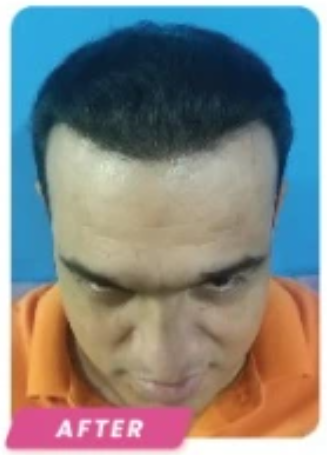
After: The same patient following a corrective Cold-Storage FUE session — improved density and a more natural hairline gradient.
Correction Techniques: DHI and Sapphire FUE
SMC Aesthetics uses two primary techniques for corrective work, often in combination within the same session:
DHI (Direct Hair Implantation) for Hairline Refinement
DHI uses a Choi Implanter Pen to simultaneously create the recipient channel and implant the follicle in a single motion. This is particularly valuable in corrective cases because:
It allows precise angle and depth control when implanting singles between existing grafts.
The smaller channels reduce trauma to tissue that already has scar tissue from the first surgery.
It enables higher density packing in the hairline zone without damaging adjacent existing grafts.
Sapphire FUE for Mid-Scalp and Crown Density
For larger areas requiring density improvement (mid-scalp, crown, and temporal regions), Sapphire FUE is the preferred method. Sapphire blades create smaller, more precise recipient channels than steel blades, which is critical in corrective work where the tissue has already been compromised. The finer channels also produce less post-operative crusting and heal faster — important for patients who have already experienced extended recovery from their first procedure.
Cold-Storage ATP Preservation
In corrective cases, graft survival is even more critical than in first-time procedures because the donor supply is limited. SMC Aesthetics uses cold-storage ATP-enriched preservation for all extracted grafts, maintaining them at optimal temperature and metabolic state during the procedure. This achieves a 97%+ graft survival rate — far above the 80–85% industry average with room-temperature saline storage — meaning that fewer grafts are wasted and each one counts toward the final result.
Realistic Expectations: What Correction Can and Cannot Achieve
⚠️ Honest Assessment: Correction Has Limits
No corrective surgeon — regardless of skill — can guarantee results identical to a well-performed first-time procedure. The following realities must be understood before committing to revision surgery:
What Correction CAN Do
What Correction CANNOT Do
Significantly improve a pluggy, unnatural hairline by adding singles and camouflaging existing multi-hair grafts
Completely erase a previous procedure and start from scratch — existing grafts and scar tissue will always be part of the landscape
Add meaningful density to sparse areas using remaining donor hair
Create the same maximum density achievable with a full, untouched donor area — the supply is permanently reduced
Camouflage FUT strip scars using FUE grafts placed directly into and around the scar tissue
Guarantee graft survival in heavy scar tissue at the same rate as healthy scalp tissue
Correct the direction and angle of growth in areas where new grafts are placed alongside or between existing ones
Change the growth direction of previously transplanted grafts without extracting and re-implanting them — which uses additional donor supply
Rebuild a patient's confidence with a significantly improved, more natural appearance
Reverse all psychological damage from the first experience — patients should consider professional support alongside surgical correction
At SMC Aesthetics, we frame corrective work as "optimisation" rather than "perfection." The goal is to take a result that is visibly artificial and transform it into something that looks natural and confident — even if it doesn't match what could have been achieved with a competent first-time procedure.
Red Flags to Avoid — Choosing Your Clinic the First Time
If you are researching hair transplants for the first time and want to avoid ever needing corrective work, these are the warning signs we see repeatedly in the histories of correction patients. This list is based on real patterns observed by Dr. Mateen Ahmed across hundreds of assessments, not theoretical concerns:
🚩 Critical Red Flags
"Unlimited grafts" at a fixed low price — no clinic has unlimited donor hair. This claim means they either won't deliver what they promise, or they'll overharvest your donor area recklessly.
The surgeon doesn't personally design your hairline — if a technician draws your hairline and the surgeon only appears for 10 minutes of a 6-hour surgery, you are in a technician-led clinic, regardless of what their marketing says.
No trichoscopy or scalp analysis before quoting a graft count — a graft count should be based on clinical measurement of your donor density and recipient area requirements, not a visual guess over a video call.
Pressure to book same-day or "limited slots available" urgency — ethical clinics will always encourage you to go home, think, and get a second opinion.
Before/after photos that only show one angle — a legitimate clinic shows frontal, profile, top-down, and donor-area views. A single selfie-angle photo can hide significant problems.
No clear answer to "who performs the extraction and implantation?" — this is the most important question you can ask. If the answer is vague, it's technician-led.
Corrective hair transplant surgery typically costs more per graft than a standard first-time procedure. This is because:
The surgical time per graft is longer due to working around existing grafts and scar tissue.
The pre-operative assessment and planning phase is more intensive.
Advanced techniques like DHI implanter pens (which are used disposably for each patient) add to the consumable cost.
At SMC Aesthetics, corrective case pricing is assessed individually after the consultation because no two correction cases are identical. We provide a transparent, itemised quote with no hidden charges — exactly as described on our main hair transplant page.
Recovery Timeline
Phase
Timeline
What to Expect
Post-Op Recovery
Days 1–10
Mild swelling and crusting. Similar to first-time recovery, though healing may be slightly slower in areas with prior scar tissue.
Shedding Phase
Weeks 2–6
Transplanted hair shafts shed (normal). The follicle root remains embedded and begins generating new growth.
Early Growth
Months 3–6
New hair begins appearing. The corrective improvement becomes progressively visible as hairs grow and thicken.
Full Maturity
Months 12–18
Final result. In corrective cases, full maturity may take slightly longer (up to 18 months) compared to 12 months for first-time FUE.
Who Is a Good Candidate for Corrective Hair Transplant?
Not every patient who is unhappy with their previous procedure is a candidate for surgical correction. The key qualifying criteria include:
Sufficient remaining donor hair — verified through trichoscopy. If the first clinic overharvested to the point where donor density is below 50 FU/cm², correction options become severely limited.
Stable hair loss — if your hair loss pattern is still progressing rapidly, corrective surgery should be deferred until the loss stabilises (sometimes with PRP therapy as a bridge).
Realistic expectations — the patient must understand that correction is optimisation, not a complete reset.
At least 10–12 months since the previous procedure — this allows all previously transplanted grafts to fully mature, giving the corrective surgeon an accurate picture of what exists.
Common Correction Scenarios We Handle
Based on Dr. Mateen Ahmed's clinical experience at SMC Aesthetics, the most frequent correction scenarios fall into three categories:
Hairline Refinement Only (most common): The original surgeon created a straight, "wall-like" hairline rather than the natural irregular, slightly receded temple points that characterise a masculine adult hairline. This typically requires 800–1,200 single-hair grafts placed via DHI to soften and naturalise the transition. Recovery is faster, and results are visible within 6 months.
Density Augmentation: The first procedure placed grafts too sparsely across a large area, resulting in see-through coverage that looks worse than the original thinning. We add density strategically using Sapphire FUE, prioritising the areas of highest visual impact (frontal third and part-line) rather than spreading grafts evenly across the entire recipient zone.
Full Revision (complex): This involves extracting previously placed pluggy grafts, splitting them into natural follicular units, and re-implanting them alongside new grafts harvested from the remaining donor area. This is the most technically demanding scenario and often requires two sessions spaced 10–12 months apart for optimal results.
Why Choose SMC Aesthetics for Corrective Work
Dr. Mateen Ahmed is a PMDC-registered specialist with an MBBS from Dow University and extensive experience in corrective cases. Key differentiators for revision surgery at SMC:
Surgeon-performed extraction and placement — not delegated to technicians.
Cold-storage ATP graft preservation — 97%+ survival rate, critical when donor supply is limited.
Two clinic locations in Karachi — DHA Phase 2 and Baldia Town — making follow-up accessible.
Honest pre-surgical assessment — we will tell you if correction isn't viable or if expectations need adjustment before any commitment.
Quick Answer: A corrective hair transplant repairs visible damage from a poorly performed first procedure — pluggy hairlines, unnatural graft angles, overharvested donor areas, and low-density placement. At SMC Aesthetics in Karachi, Dr. Mateen Ahmed uses DHI and Sapphire FUE to camouflage previous scarring and rebuild natural-looking density, though honest expectations are critical: correction improves significantly but rarely matches a well-executed first-time result.
What Goes Wrong With Cheap or Rushed Hair Transplants
Pakistan's hair transplant industry has grown rapidly over the past decade, particularly in Karachi. With that growth has come a surge in clinics offering extremely low-cost procedures — sometimes as low as PKR 25,000–40,000 for a full session. While this sounds appealing, the clinical reality is that cutting costs in hair transplantation almost always means cutting corners on the factors that determine whether your result looks natural or noticeably artificial.
Here are the most common problems we see in patients who come to SMC Aesthetics seeking corrective work after a failed procedure elsewhere:
1. Pluggy, Unnatural Hairline Design
This is the single most visible sign of a bad hair transplant. Instead of placing single-hair follicular units at the hairline (which is how natural hairlines grow), some clinics transplant multi-follicular unit grafts (containing 3–4 hairs each) directly at the front. The result is a row of thick, clustered "plugs" that look like doll's hair rather than a natural gradient from fine singles at the front to denser multi-hair units behind.
Correcting this requires removing or camouflaging these plugs — often by splitting them into individual follicles and re-implanting them at correct angles, which demands significantly more precision than the original surgery.
2. Wrong Hairline Angle and Direction
Natural hair doesn't grow straight up from the scalp. At the temporal regions, hair angles forward and slightly downward. At the crown, it grows in a whorl pattern. At the frontal hairline, the angle is approximately 30–45 degrees relative to the scalp surface. When a surgeon or technician doesn't understand or control these angles, the transplanted hair grows in visibly wrong directions — sometimes sticking straight out, sometimes growing backward. This cannot be fixed by simply shaving or styling; it requires extracting and re-implanting the grafts at the correct angle.
3. Overharvested Donor Areas
The donor area — the back and sides of the head where DHT-resistant hair grows — is a finite resource. A responsible surgeon harvests evenly across the safe donor zone to maintain uniform density. In high-volume "hair mills," technicians sometimes strip-mine a small area aggressively to save time, leaving a visibly thin or patchy donor region. This is particularly devastating because:
The damage is permanent — those follicles don't regenerate.
It limits the donor supply available for any future corrective procedure.
It can leave visible scarring or bald patches on the back of the head that are difficult to conceal.
4. Poor Density Distribution
A common shortcut in budget clinics is to spread grafts too thinly across a large area to create an illusion of coverage, or conversely, to pack grafts densely at the hairline while leaving the mid-scalp and crown completely untouched. Both approaches look unnatural. Proper density requires 40–50 follicular units per square centimetre at the hairline, gradually transitioning to 30–35 FU/cm² in the mid-scalp. Achieving this requires careful pre-surgical planning and sufficient graft allocation — not arbitrary placement.
5. Visible Linear Scarring (FUT Strip Damage)
Older FUT (Follicular Unit Transplantation) procedures involve cutting a strip of scalp from the donor area and suturing it closed. When done well, the resulting scar is a thin, barely visible line. When done poorly — with excessive tension, poor suturing technique, or on a patient with poor wound healing — the scar can be wide, raised (keloid or hypertrophic), and clearly visible even with moderately short hair. We see this frequently in patients who had their FUT procedure performed by general practitioners rather than trained plastic surgeons.
Before: A patient presenting for corrective assessment — note the uneven density distribution from a previous procedure.
Why Corrective Surgery Is Technically Harder Than a First-Time Case
Many patients assume that fixing a bad hair transplant is simply a matter of "doing it again, but better." The reality is significantly more complex. Here is why correction cases are categorised as advanced procedures that should only be attempted by experienced surgeons:
Limited Remaining Donor Supply
If 2,500–3,000 grafts were already extracted (or wasted) in the first procedure, the total remaining donor capacity may be reduced to 1,500–2,500 grafts for the correction. This means the corrective surgeon must achieve maximum impact with fewer resources — a constraint that doesn't exist in first-time cases where the full donor reserve (typically 5,000–7,000 total grafts over a lifetime) is available.
Existing Scar Tissue
Previous surgery creates scar tissue in both the donor and recipient areas. Scar tissue has reduced blood supply compared to healthy scalp tissue, which means grafts planted into scarred areas have a lower survival rate. The surgeon must identify where scar tissue exists, plan around it where possible, and use techniques (like smaller recipient channel creation with sapphire blades) that minimise further trauma to already-compromised tissue.
The Camouflage Challenge
In a first-time transplant, the surgeon works with a blank canvas. In a corrective case, the surgeon must work around existing (poorly placed) grafts. The goal isn't to build from scratch — it's to camouflage mistakes while blending the new work seamlessly with whatever existing transplanted hair can be salvaged. This requires a three-dimensional understanding of hair growth patterns and an artistic eye that goes well beyond basic surgical skill.
Psychological Impact
Patients seeking correction have already been through a traumatic experience. Their trust in the process is damaged, and their anxiety about outcomes is significantly higher. This creates additional pressure on the surgeon to communicate honestly, set realistic expectations, and deliver results that rebuild the patient's confidence — not just their hairline.
SMC's Correction Assessment Process
At SMC Aesthetics, every corrective case begins with an extended consultation that is fundamentally different from a standard first-visit assessment. Here is what Dr. Mateen Ahmed's evaluation involves:
Step 1: Full Donor Area Audit
Using trichoscopy (a specialised scalp microscope), we map the entire donor zone to calculate remaining follicular unit density. This tells us exactly how many grafts are safely extractable without causing further donor thinning. If the previous clinic overharvested a specific region, we identify alternative extraction zones (sometimes including beard or body hair for patients with severely depleted scalp donors).
Step 2: Existing Graft Assessment
We examine every existing transplanted graft in the recipient area to determine:
Which grafts are growing at acceptable angles and can be kept.
Which grafts need to be extracted, split (in the case of multi-hair plugs at the hairline), and re-implanted.
Where scar tissue from previous recipient channel creation will limit new graft placement.
Step 3: Custom Correction Plan
Based on the audit, we create a staged correction plan. In many cases, correction is performed in two sessions spaced 8–12 months apart, to allow the first round of corrective grafts to establish blood supply and begin growing before adding density in the second round. This staged approach maximises graft survival in tissue that has already been surgically compromised.
After: The same patient following a corrective Cold-Storage FUE session — improved density and a more natural hairline gradient.
Correction Techniques: DHI and Sapphire FUE
SMC Aesthetics uses two primary techniques for corrective work, often in combination within the same session:
DHI (Direct Hair Implantation) for Hairline Refinement
DHI uses a Choi Implanter Pen to simultaneously create the recipient channel and implant the follicle in a single motion. This is particularly valuable in corrective cases because:
It allows precise angle and depth control when implanting singles between existing grafts.
The smaller channels reduce trauma to tissue that already has scar tissue from the first surgery.
It enables higher density packing in the hairline zone without damaging adjacent existing grafts.
Sapphire FUE for Mid-Scalp and Crown Density
For larger areas requiring density improvement (mid-scalp, crown, and temporal regions), Sapphire FUE is the preferred method. Sapphire blades create smaller, more precise recipient channels than steel blades, which is critical in corrective work where the tissue has already been compromised. The finer channels also produce less post-operative crusting and heal faster — important for patients who have already experienced extended recovery from their first procedure.
Cold-Storage ATP Preservation
In corrective cases, graft survival is even more critical than in first-time procedures because the donor supply is limited. SMC Aesthetics uses cold-storage ATP-enriched preservation for all extracted grafts, maintaining them at optimal temperature and metabolic state during the procedure. This achieves a 97%+ graft survival rate — far above the 80–85% industry average with room-temperature saline storage — meaning that fewer grafts are wasted and each one counts toward the final result.
Realistic Expectations: What Correction Can and Cannot Achieve
⚠️ Honest Assessment: Correction Has Limits
No corrective surgeon — regardless of skill — can guarantee results identical to a well-performed first-time procedure. The following realities must be understood before committing to revision surgery:
What Correction CAN Do
What Correction CANNOT Do
Significantly improve a pluggy, unnatural hairline by adding singles and camouflaging existing multi-hair grafts
Completely erase a previous procedure and start from scratch — existing grafts and scar tissue will always be part of the landscape
Add meaningful density to sparse areas using remaining donor hair
Create the same maximum density achievable with a full, untouched donor area — the supply is permanently reduced
Camouflage FUT strip scars using FUE grafts placed directly into and around the scar tissue
Guarantee graft survival in heavy scar tissue at the same rate as healthy scalp tissue
Correct the direction and angle of growth in areas where new grafts are placed alongside or between existing ones
Change the growth direction of previously transplanted grafts without extracting and re-implanting them — which uses additional donor supply
Rebuild a patient's confidence with a significantly improved, more natural appearance
Reverse all psychological damage from the first experience — patients should consider professional support alongside surgical correction
At SMC Aesthetics, we frame corrective work as "optimisation" rather than "perfection." The goal is to take a result that is visibly artificial and transform it into something that looks natural and confident — even if it doesn't match what could have been achieved with a competent first-time procedure.
Red Flags to Avoid — Choosing Your Clinic the First Time
If you are researching hair transplants for the first time and want to avoid ever needing corrective work, these are the warning signs we see repeatedly in the histories of correction patients. This list is based on real patterns observed by Dr. Mateen Ahmed across hundreds of assessments, not theoretical concerns:
🚩 Critical Red Flags
"Unlimited grafts" at a fixed low price — no clinic has unlimited donor hair. This claim means they either won't deliver what they promise, or they'll overharvest your donor area recklessly.
The surgeon doesn't personally design your hairline — if a technician draws your hairline and the surgeon only appears for 10 minutes of a 6-hour surgery, you are in a technician-led clinic, regardless of what their marketing says.
No trichoscopy or scalp analysis before quoting a graft count — a graft count should be based on clinical measurement of your donor density and recipient area requirements, not a visual guess over a video call.
Pressure to book same-day or "limited slots available" urgency — ethical clinics will always encourage you to go home, think, and get a second opinion.
Before/after photos that only show one angle — a legitimate clinic shows frontal, profile, top-down, and donor-area views. A single selfie-angle photo can hide significant problems.
No clear answer to "who performs the extraction and implantation?" — this is the most important question you can ask. If the answer is vague, it's technician-led.
Corrective hair transplant surgery typically costs more per graft than a standard first-time procedure. This is because:
The surgical time per graft is longer due to working around existing grafts and scar tissue.
The pre-operative assessment and planning phase is more intensive.
Advanced techniques like DHI implanter pens (which are used disposably for each patient) add to the consumable cost.
At SMC Aesthetics, corrective case pricing is assessed individually after the consultation because no two correction cases are identical. We provide a transparent, itemised quote with no hidden charges — exactly as described on our main hair transplant page.
Recovery Timeline
Phase
Timeline
What to Expect
Post-Op Recovery
Days 1–10
Mild swelling and crusting. Similar to first-time recovery, though healing may be slightly slower in areas with prior scar tissue.
Shedding Phase
Weeks 2–6
Transplanted hair shafts shed (normal). The follicle root remains embedded and begins generating new growth.
Early Growth
Months 3–6
New hair begins appearing. The corrective improvement becomes progressively visible as hairs grow and thicken.
Full Maturity
Months 12–18
Final result. In corrective cases, full maturity may take slightly longer (up to 18 months) compared to 12 months for first-time FUE.
Who Is a Good Candidate for Corrective Hair Transplant?
Not every patient who is unhappy with their previous procedure is a candidate for surgical correction. The key qualifying criteria include:
Sufficient remaining donor hair — verified through trichoscopy. If the first clinic overharvested to the point where donor density is below 50 FU/cm², correction options become severely limited.
Stable hair loss — if your hair loss pattern is still progressing rapidly, corrective surgery should be deferred until the loss stabilises (sometimes with PRP therapy as a bridge).
Realistic expectations — the patient must understand that correction is optimisation, not a complete reset.
At least 10–12 months since the previous procedure — this allows all previously transplanted grafts to fully mature, giving the corrective surgeon an accurate picture of what exists.
Common Correction Scenarios We Handle
Based on Dr. Mateen Ahmed's clinical experience at SMC Aesthetics, the most frequent correction scenarios fall into three categories:
Hairline Refinement Only (most common): The original surgeon created a straight, "wall-like" hairline rather than the natural irregular, slightly receded temple points that characterise a masculine adult hairline. This typically requires 800–1,200 single-hair grafts placed via DHI to soften and naturalise the transition. Recovery is faster, and results are visible within 6 months.
Density Augmentation: The first procedure placed grafts too sparsely across a large area, resulting in see-through coverage that looks worse than the original thinning. We add density strategically using Sapphire FUE, prioritising the areas of highest visual impact (frontal third and part-line) rather than spreading grafts evenly across the entire recipient zone.
Full Revision (complex): This involves extracting previously placed pluggy grafts, splitting them into natural follicular units, and re-implanting them alongside new grafts harvested from the remaining donor area. This is the most technically demanding scenario and often requires two sessions spaced 10–12 months apart for optimal results.
Why Choose SMC Aesthetics for Corrective Work
Dr. Mateen Ahmed is a PMDC-registered specialist with an MBBS from Dow University and extensive experience in corrective cases. Key differentiators for revision surgery at SMC:
Surgeon-performed extraction and placement — not delegated to technicians.
Cold-storage ATP graft preservation — 97%+ survival rate, critical when donor supply is limited.
Two clinic locations in Karachi — DHA Phase 2 and Baldia Town — making follow-up accessible.
Honest pre-surgical assessment — we will tell you if correction isn't viable or if expectations need adjustment before any commitment.
Can a failed hair transplant from another clinic actually be fixed?
Yes. Corrective hair transplant surgery can significantly improve results from a poorly performed procedure. At SMC Aesthetics, Dr. Mateen Ahmed uses DHI and Sapphire FUE to camouflage pluggy grafts, add density, and rebuild a natural hairline. However, correction is technically harder than a first-time procedure and results depend on remaining donor supply.
How long should I wait before getting a revision hair transplant?
You should wait a minimum of 10–12 months after your original procedure. This allows all transplanted grafts to fully mature, giving the corrective surgeon an accurate picture of what exists and what needs to be changed. Proceeding too early risks damaging grafts that are still establishing blood supply.
Is corrective hair transplant more expensive than a standard procedure?
Generally yes. Correction requires more surgical time per graft due to working around existing grafts and scar tissue, more intensive pre-operative planning, and advanced techniques like DHI implanter pens. At SMC Aesthetics, pricing is assessed individually after consultation because no two correction cases are identical.
Can you fix a pluggy or "doll's hair" hairline from a previous clinic?
Yes, this is one of the most common corrections we perform. The approach involves adding single-hair follicular units between and in front of the existing multi-hair plugs to create a natural gradient. In some cases, the pluggy grafts themselves are extracted, split into singles, and re-implanted at correct angles.
What if my donor area was overharvested by the previous clinic?
Overharvested donor areas limit the total grafts available for correction. During the trichoscopy assessment, we map the entire remaining donor zone to calculate exactly how many grafts can be safely extracted. In severe cases, we may recommend beard or body hair as supplementary donor sources, or a staged approach using fewer grafts per session.
Will the corrective procedure leave more scars?
SMC Aesthetics uses micro-punch FUE extraction (0.8–1.0mm) which leaves tiny dot-like marks that are virtually invisible once surrounding hair grows. For recipient-area correction, sapphire blade channels are smaller and heal faster than steel blade channels. The overall scarring from correction is typically less visible than from the original poorly performed procedure.
Do you use DHI specifically for corrective hairline surgeries?
Yes. DHI (Direct Hair Implantation) with the Choi Implanter Pen is our preferred technique for hairline correction specifically because it allows precise angle, depth, and direction control when implanting single-hair grafts between existing transplanted hair — a precision requirement that standard forceps placement cannot match in revision cases.
Can correction achieve the same results as a well-done first-time transplant?
Honestly, no. Corrective surgery is optimisation, not a reset. The limited remaining donor supply, existing scar tissue, and the need to work around previously placed grafts mean that the absolute maximum achievable density and naturalness will be somewhat lower than what a well-executed first-time procedure on a fresh scalp could achieve. That said, the improvement from a bad result to a corrected result is typically dramatic and life-changing.



Discussion (0)